G
Analytics-Driven Learning: How Data Improves Team Performance
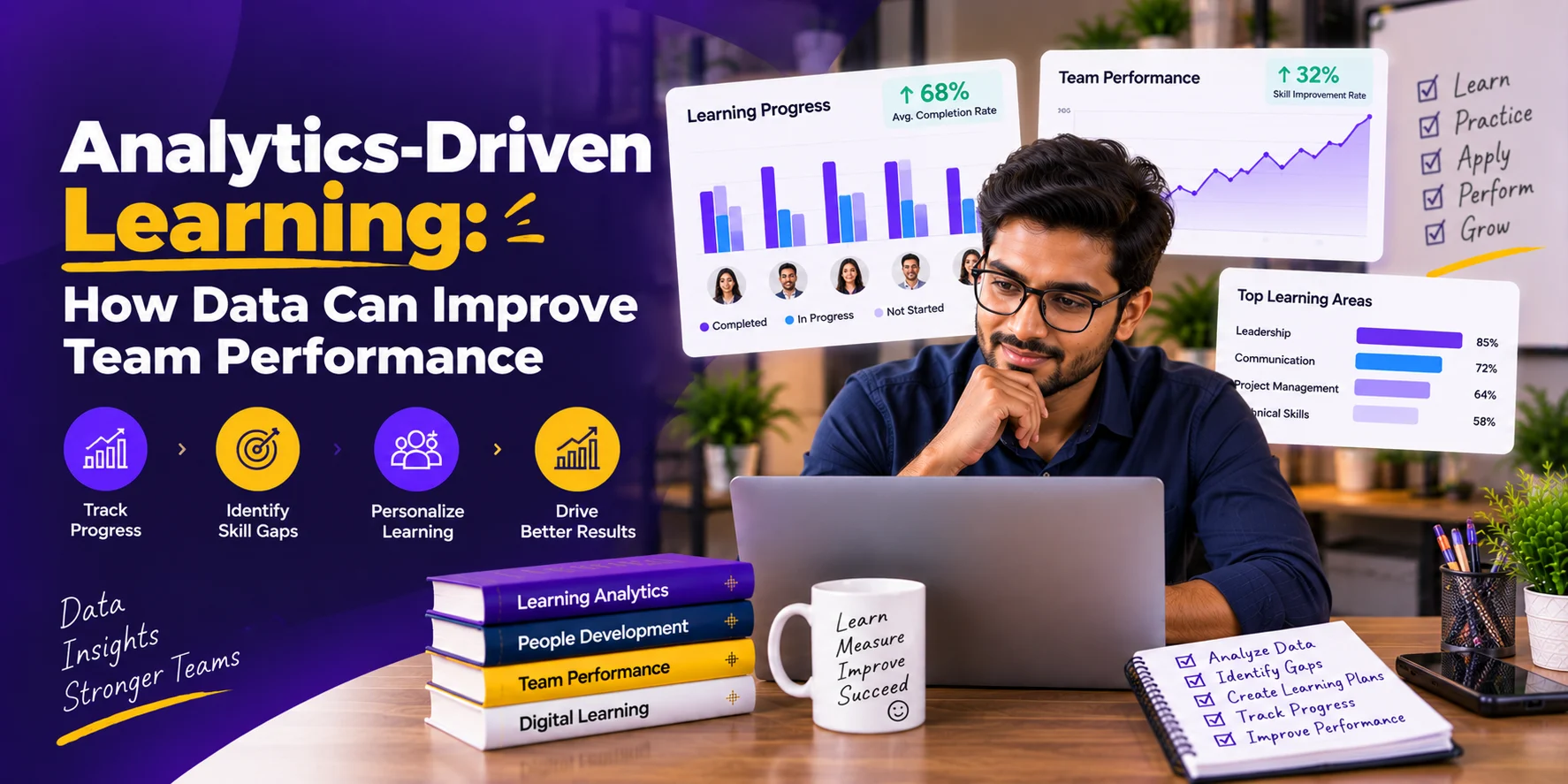
What if your employee training programme could tell you more than who completed a course? What if it could reveal where learners struggle, which lessons need improvement, and whether training is helping your team perform better at work?
That is exactly where analytics-driven learning makes a difference.
By using learning analytics to understand employee behaviour, training progress, and skill development, businesses can move beyond completion reports and make more informed learning and development decisions.
Instead of treating training as a one-time activity, organisations can build a continuous improvement process that connects learning with measurable business outcomes.
What Is Analytics-Driven Learning?
Analytics-driven learning is an approach to employee training that uses learning data to understand learner behaviour, identify skill gaps, improve course content, and measure training effectiveness.
Modern Learning Management Systems (LMS) collect information such as course completion rates, assessment scores, learner engagement, time spent on lessons, and training progress. When analysed effectively, these insights help L&D teams understand what is working and where support is needed.
For example, if employees consistently struggle with a particular product training module, the learning team can review the content, introduce practical exercises, or provide additional guidance.
The goal is simple: use real learning behaviour to make training more relevant, useful, and connected to workplace performance.
Why Learning Analytics Matters for Team Performance
Traditional training reports often focus on basic numbers: how many employees enrolled, how many completed a course, and how many hours they spent learning.
These numbers are useful, but they do not always explain whether employees understood the material or applied it successfully in their roles.
Learning analytics adds context to these reports. It helps organisations investigate learning patterns, identify areas that need attention, and make better decisions about their training investments.
Here are five practical ways data-driven learning can improve employee development and team performance.
1. Identify Skill Gaps Before They Affect Performance
One of the biggest advantages of learning analytics is the ability to identify knowledge gaps early.
Instead of waiting for performance reviews or customer complaints to highlight a problem, L&D teams can examine assessment results, repeated attempts, incomplete modules, and learner feedback to understand where employees need help.
Example: Sales Team Training
Imagine a sales team completing a product training programme. Most employees perform well in product knowledge assessments, but a large number struggle with the negotiation module.
This pattern could indicate that the lesson needs clearer explanations, more practical examples, or additional role-playing exercises.
By identifying the issue through learning data, the organisation can improve the training before the knowledge gap becomes a larger workplace challenge.
Business benefit: More targeted training, better knowledge development, and earlier intervention when employees need support.
2. Personalise Employee Training at Scale
Not every employee needs the same training. A new sales representative may need product fundamentals, while an experienced team leader may benefit more from coaching and leadership development.
Learning analytics helps organisations understand these differences and create more relevant learning journeys.
With an LMS that supports learner segmentation, learning paths, and automation, organisations can assign training based on role, department, skill level, or learning progress.
How Personalised Learning Works
- New employees receive onboarding and foundational training.
- Employees with assessment gaps receive additional learning resources.
- Managers access leadership and team development programmes.
- Advanced learners progress to specialised courses.
AI-powered learning features can further support this process by helping recommend relevant content or learning activities, depending on the platform's capabilities and available data.
Business benefit: Employees spend more time learning skills relevant to their roles instead of following a generic training path.
3. Connect Learning Outcomes with Business KPIs
Completing a course is an important milestone, but it does not automatically prove that training improved workplace performance.
To understand the real value of employee training, businesses need to connect learning metrics with relevant operational and business indicators.
Learning Metrics Worth Tracking
- Course completion rate: How many learners finish assigned training?
- Assessment performance: How well do employees understand the material?
- Learning progress: Are employees moving through their learning paths?
- Engagement: Which lessons receive consistent participation?
- Knowledge retention: Can learners recall important concepts after training?
- Skill application: Are employees using their new knowledge at work?
Connecting Training with Business Results
A sales organisation might compare product training results with sales conversion trends. A customer support team could examine whether employees who complete service training demonstrate improvements in relevant quality measures.
These comparisons can reveal useful patterns, although correlation alone does not prove that training caused a business improvement. Other factors, such as experience, management support, and market conditions, may also influence results.
Business benefit: L&D teams gain a clearer picture of training effectiveness and can communicate its contribution using measurable evidence.
4. Improve Training Content Using Real Learner Behaviour
Sometimes a course looks excellent during development but performs differently once employees start using it.
Learning analytics can help reveal where learners repeatedly pause, revisit lessons, skip content, or provide negative feedback, where these signals are supported by the LMS.
Questions Learning Data Can Help Answer
- Which lessons have unusually high drop-off rates?
- Which assessment questions are frequently answered incorrectly?
- Are learners repeatedly revisiting a particular topic?
- Which courses receive consistently positive or negative feedback?
- Are lengthy modules affecting course completion?
For example, if learners repeatedly struggle with a technical lesson, the content team might introduce diagrams, short videos, interactive examples, or a simpler explanation.
Over time, this creates a continuous improvement cycle: publish, measure, review, refine, and measure again.
Business benefit: Training content becomes more useful and easier to navigate as it evolves around actual learner needs.
5. Increase Learner Engagement with Timely Nudges
Even well-designed training can lose momentum when employees become busy with daily responsibilities.
Learning analytics can help identify inactivity, missed milestones, or learners who may need a reminder. LMS automation can then deliver timely notifications based on supported learner activity.
Examples of Learning Nudges
- Reminders for employees who have not started assigned training.
- Progress notifications when learners approach a deadline.
- Encouragement after completing important milestones.
- Follow-up learning recommendations after an assessment.
- Notifications to managers when additional support may be needed.
The key is to make these reminders helpful rather than overwhelming. A well-timed nudge should make learning easier to continue, not create unnecessary pressure.
Business benefit: Better visibility into learner progress and more opportunities to support employees before they disengage.
Which Learning Analytics Metrics Should L&D Teams Track?
Tracking every available metric can create unnecessary complexity. The most useful approach is to select metrics based on the training objective.
| Metric | What It Reveals | Why It Matters |
|---|---|---|
| Course completion rate | Training completion patterns | Helps identify participation gaps |
| Assessment scores | Knowledge and understanding | Highlights topics requiring reinforcement |
| Time spent learning | Learning activity and pacing | Provides context for course engagement |
| Drop-off rate | Where learners stop progressing | Helps identify potential content or accessibility issues |
| Knowledge retention | Recall after a period of time | Shows whether learning is lasting |
| Skill application | Use of learning in the workplace | Connects training with practical outcomes |
| Business performance indicators | Relevant operational trends | Helps evaluate training contribution |
Remember that a high completion rate does not necessarily mean employees have mastered a skill. Combining participation, assessment, feedback, and workplace performance data provides a more complete picture.
How to Build a Data-Driven Learning Strategy
You do not need to transform your entire training programme overnight. Start with a clear objective and build your analytics process step by step.
- Define the business objective. Decide what the training should improve, such as product knowledge, onboarding readiness, customer service quality, or role-specific skills.
- Choose relevant learning metrics. Select a small set of indicators that directly relate to the objective.
- Use an LMS with meaningful reporting. Look for dashboards, assessment reports, learner progress tracking, and export options that support your requirements.
- Review learner behaviour regularly. Identify recurring knowledge gaps, participation issues, and content improvement opportunities.
- Make targeted improvements. Update course material, provide additional resources, or adjust learning paths based on the findings.
- Measure the results again. Compare outcomes against your original objectives and continue refining the programme.
How Gyaankool Helps Make Learning More Measurable
Managing employee training becomes easier when learning activities, progress, and course delivery are organised through a central platform.
Gyaankool helps businesses and learning professionals manage digital learning experiences and build structured training programmes.
By using the platform's available course management, learner progress, and reporting capabilities, organisations can bring greater visibility to their learning initiatives.
Whether you are onboarding new employees, delivering professional development, or managing internal training, a structured LMS can support a more consistent learning experience.
Want to make your training more organised and measurable? Explore Gyaankool to learn how a digital learning platform can support your training and development goals.
Final Thoughts: Turn Learning Data into Meaningful Progress
Training data becomes valuable when it helps organisations make better decisions.
From identifying skill gaps and personalising learning journeys to improving course content and measuring workplace outcomes, analytics gives L&D teams a clearer understanding of how their programmes are performing.
The real opportunity is not simply collecting more data. It is using the right insights to create learning experiences that help employees grow and teams perform with greater confidence.
With Gyaankool, businesses can take a more structured approach to digital learning and make every training initiative easier to manage, review, and improve.
Frequently Asked Questions
Learning analytics in an LMS refers to collecting and analysing training data such as course progress, completion rates, assessment results, and learner engagement to understand and improve learning outcomes.
Data-driven learning helps organisations identify skill gaps, personalise training, improve course content, and evaluate whether employees are applying new knowledge in their roles.
Common L&D metrics include course completion rates, assessment scores, learner engagement, knowledge retention, skill application, and relevant business performance indicators.
Learning analytics can help organisations identify ineffective content, prioritise training needs, and allocate learning resources more effectively. Actual cost savings depend on the organisation, training design, and implementation.